Diane Levesque
Why These Things? The Origin and Cause of Every Delight Maelstrom The Magician Temperance Dr. Burling's Cabinet of Curiosities The Aleph Judgement Day I Angel of the Apocalypse I: Kathy Angel of the Apocalpyse II: Elizabeth Angel of the Apocalypse III: Jennifer Angel of the Apocalypse IV: Chris Angel of the Apocalypse V: Jay Angel of the Apocalypse VI: Jen Angel of the Apocalypse VII: Krista Bird Fantasy I Bird Fantasy II Bird Fantasy III Bird Fantasy IV: Rag & Bones Tom Foolery Bird Fantasy VI: Two Bees Insecurity The Angel, The Devil, and Hell Borges & the Minotaur Unworthy James Joyce: He Domesticated His Metaphysics In the Country of the Marvelous An Awkward Comparison Stuart Davis: The Cool Fool of the Yale Art School Debris of Life and Mind Leger: He Ate the Void for Food Oedipus & Jocasta: All Things Being Equal The Realm of Equilibrium Crazy Dumbsaint of the Mind A Little World Made Cunningly
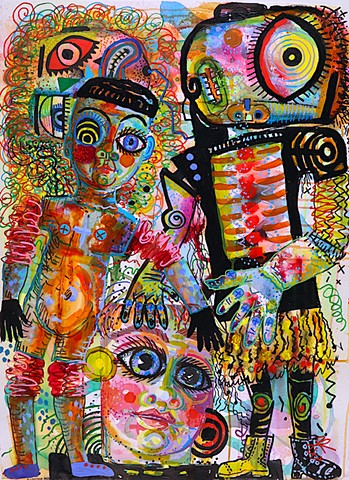
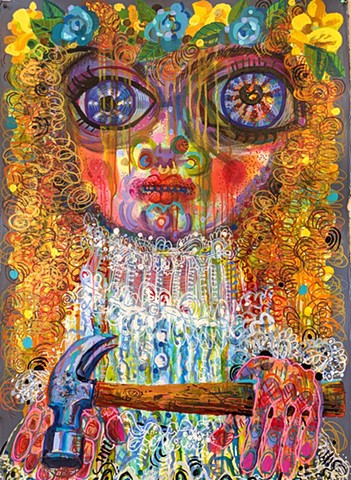
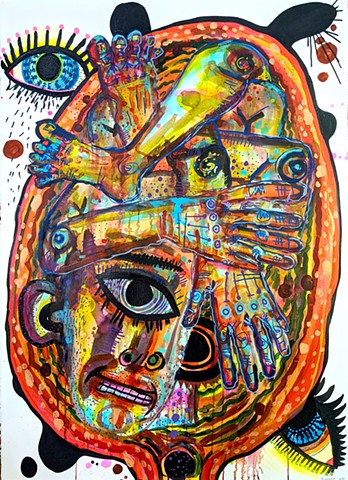
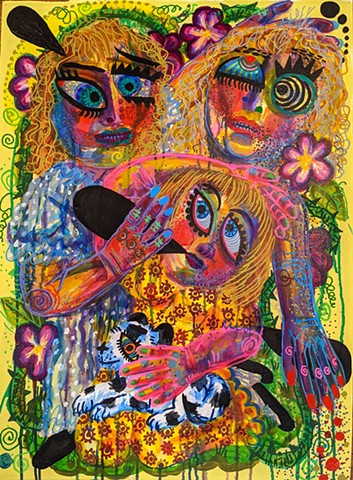
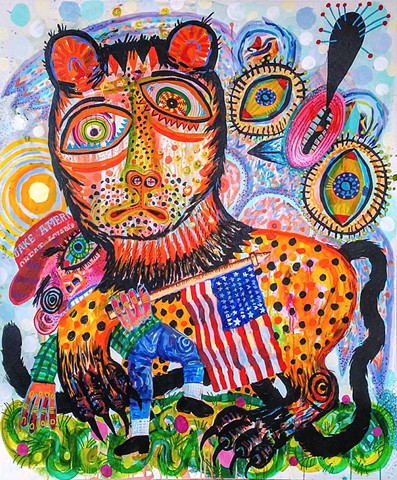
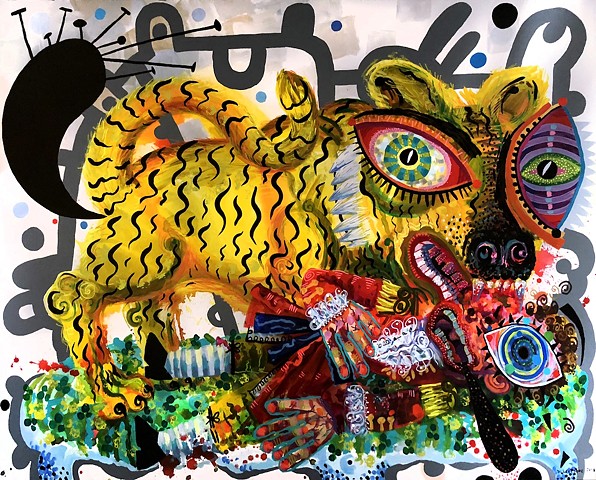
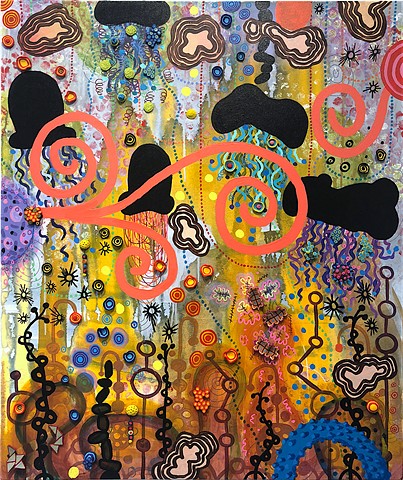
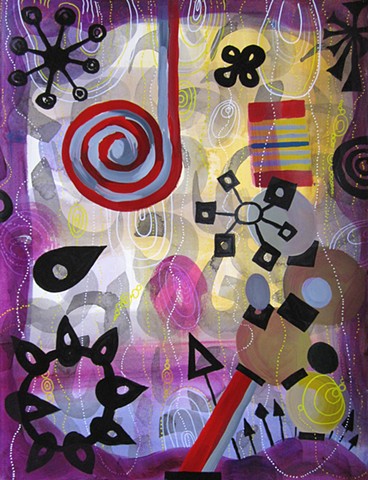
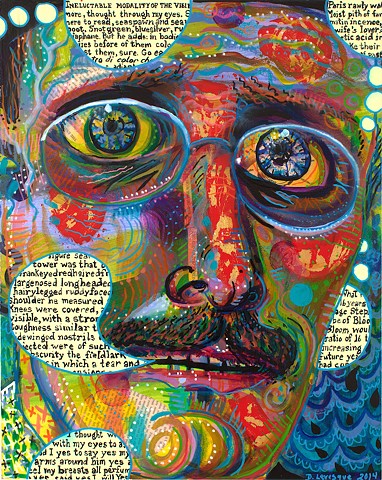
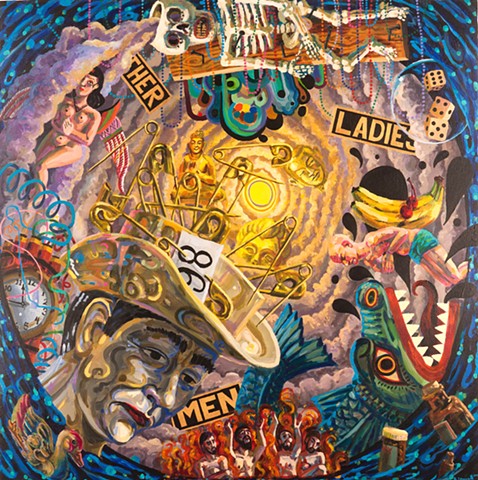
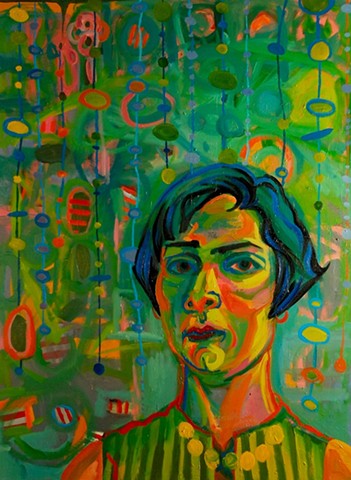
Diane Levesque's paintings encapsulate multiple narratives that contain personal, philosophical, literary and political references.

Often working in thematic series, she depicts ordinary and kitsch-type objects that she likens to "characters in a play" alongside appropriated, two- dimensional imagery, hand-painted fragments of texts, and linear elements. These objects most always appear in relationship to a main figure who is the subject of the painting in which the scale is distorted to suit a symbolic order, much like the hierarchy of religious figures as seen in 16th century Northern Renaissance paintings.

In addition, Levesque manipulates spatial, temporal and gravitational expectations in order to render the sense of place as unstable and liminal. The substance of the objects is important to interpretation. Glass objects are seductive because of their transparency that distorts what lies behind the objects and the fluidity of that distortion. Glass implies fragility and danger, calling to mind the adage about "glass houses". Measuring devices such as rulers, compasses, hourglasses, clocks, measuring tapes and measuring cups bring a reassuring domesticity, yet they also serve to remind us that we might not be quite measuring up to our potential, that we have taken more than our fair share, or that the years are passing us by.

Each painting is a visualization of thought arrested in the marginalia of life with obsessions, fixations and distractions pulled out from the shadows of the unconscious.

As Garret Holg, art critic and writer for ARTnews magazine wrote in 2004:

A great deal of psychological complexity is packed into the shallow, rather claustrophobic spaces of Diane Levesque's provocative acrylic paintings. Her subjects, whether of friends or strangers, are characterized as much by her faithful likenesses, as they are by the surreal-like accumulations of objects she brings into their orbit- objects which retain the residue of memory and which hold the clues to her subject's identity and place in time.

In 'James Joyce: He Domesticated His Metaphysics' (2004), one in a series of portraits focusing on writers and painters whom she considers influential to her own work, Levesque ingeniously recasts Joyce's retelling of Homer's epic poem "The Odyssey" into a board game with playing spaces that wind around the pictures surface like Joyce's stream-of-consciousness prose winds around the pages of a book. An extremely articulate painter, Levesque imbues the seeming chaos and irrationality of Joyce's art with her own arresting form and artistry.

Diane Levesque was born in St.Albans, Vermont and received her MFA from the University of Chicago and her BA from the State University of New York at Plattsburgh. She has had numerous one person shows and has been included in many group exhibitions including The Art Institute of Chicago, The Chicago Cultural Art Center, The Evanston Art Center in Illinois, Bradley University in Peoria, Illinois, Indiana State University, The Rockford Art Museum in Illinois, The Wisconsin Academy Art Gallery in Madison, and The James Waltrous Art Gallery in Madison, WI.

She has received a number of grants and awards including an Illinois Arts Council Fellowship Grant, a Wisconsin Arts Board Fellowship Grant, Research and Development Grants from Carthage College and the 1999 Gradiva Award for Best Art from the National Association for the Advancement of Psychoanalysis. She is an assistant professor of art and the director of the H.F.Johnson Art Gallery at Carthage College in Kenosha, Wisconsin.

Her work is represented by Peltz gallery in Milwaukee, Wisconsin.